





Mental Fitness at Work: The HR Leader's Guide | Forte
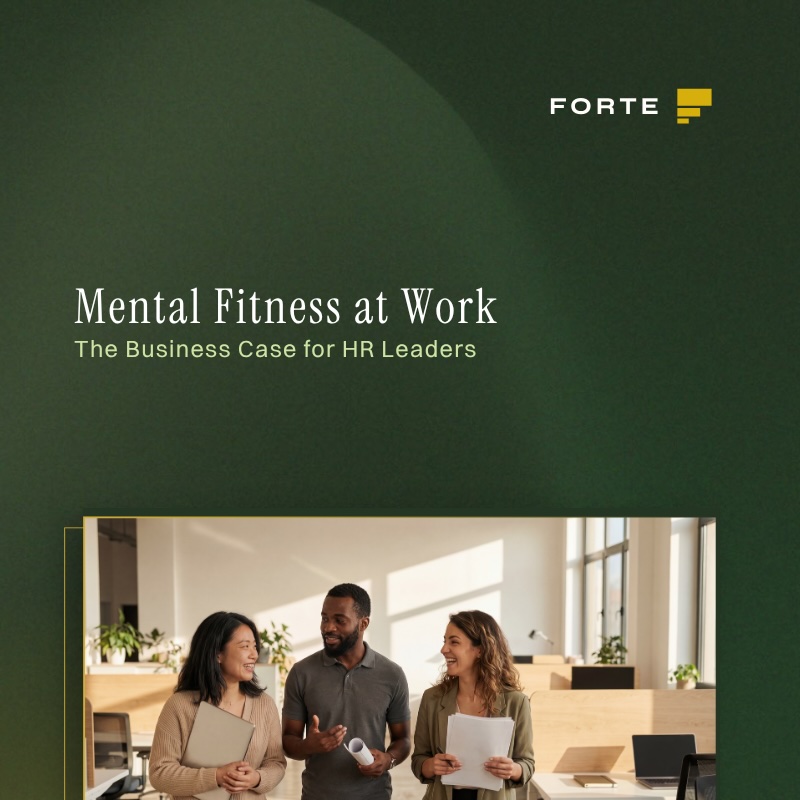
Mental Fitness at Work: The Business Case for HR Leaders
The workforce problem no one is measuring correctly
Most organizations track headcount, turnover, and productivity. Mental Fitness at work, the proactive training of your people's inner lives, is the variable missing from almost every dashboard.
When employees are mentally unfit, the cost does not show up on a single line in a budget. It spreads. It lives in the manager who can't make decisions. The high performer who quietly stops caring. The team that ships work but doesn't believe in it anymore. The person who resigns six months before they actually leave.
For HR leaders, this is the central challenge of the next decade. Not hiring. Not benefits packages. Not the next engagement survey. It is building an organization where Mental Fitness is treated as seriously as physical fitness. Where the inner life of every employee is considered a business asset, not a private matter.
That is the problem Forte is built to solve.
What Mental Fitness actually means at work
Mental Fitness is not therapy. It is not crisis support. It is not a helpline employees call when things get bad.
Think of it the way you think of the gym. Physical fitness is not what happens when you break a bone. It is the daily practice that makes you less likely to break one. It builds resilience, capacity, and performance over time. Mental Fitness works the same way.
At Forte, we define Mental Fitness as the proactive, ongoing practice of strengthening your inner life so you can perform, connect, and lead at your best. It is not about fixing what is broken. It is about building what is possible.
This distinction matters enormously for HR leaders making the case upward. Wellbeing programs that sit inside a reactive framework will always struggle to prove their value. Mental Fitness, positioned as a performance driver, speaks the language of the boardroom.
The Core Concepts Behind Forte's Approach
Forte's approach is built on a set of core concepts that together cover the full range of what it means to be mentally fit at work.
Drift is the quiet erosion that happens when people lose their sense of direction or purpose. At work, Drift looks like disengagement that isn't dramatic enough to flag. The person who used to bring energy to meetings but now just gets through them. Addressing Drift means helping employees reconnect to what matters, clarify their values, and build the kind of internal compass that keeps them steady when the external environment shifts.
Drive is the capacity to act with intention and sustain effort over time. In a workplace context, Drive is what separates people who are busy from people who are effective. When Drive is low, productivity scores suffer, deadlines slip, and managers pick up slack they shouldn't have to carry. Building Drive through Mental Fitness Reps, the short, structured practices Forte uses, helps employees show up with focus and follow through.
Inner life is perhaps the most overlooked pillar in corporate wellbeing conversations. It refers to a person's relationship with their own thoughts, emotions, and sense of self. Employees with a rich, well-tended Inner Life are more self-aware, more emotionally regulated, and better at navigating complexity and ambiguity. These are not soft skills. They are the competencies that separate good leaders from great ones.
These concepts are not siloed programs. They work together, and Forte is designed to help employees build across all of them over time.
Why inner life is a business metric
This is the conversation HR leaders need to be able to have in a CFO's office.
The case for proactive Mental Fitness is not a wellness argument. It is a performance argument. When people have the inner capacity to handle pressure, make clear decisions, and stay engaged through difficult seasons, the organization performs better. That is not a soft claim. It shows up in retention, in team cohesion, in the quality of work people produce when they are not quietly running on empty.
And yet, the way most companies think about mental health at work is still structured around the reactive. Employee Assistance Programs that most people never use until something goes wrong. One-off workshops that deliver a moment of awareness without building any lasting capacity. Apps that get downloaded and abandoned.
The fundamental problem with reactive mental health support is that it waits for a signal of distress before it intervenes. By the time someone reaches out for help, they have already been struggling for weeks or months. The cost to the organization, in lost performance, in management time, in potential turnover, has already accumulated.
Mental Fitness inverts this. It builds capacity before it is needed. It treats the inner life of an employee the way a sports team treats physical conditioning. You do not wait for an injury to start training. You build the strength that makes injuries less likely in the first place.
Why Most Wellbeing Programs Struggle to Prove Their Value
Most wellbeing programs are built to reduce liability, not build performance.
That is a structural problem. When wellbeing is framed as risk mitigation, it will always be underfunded relative to other business priorities. It lives in the benefits stack alongside dental and vision.
It gets cut when budgets tighten. And it fails to build the organizational case for sustained investment.
HR leaders who are winning this conversation upward are doing something different. They are reframing Mental Fitness as a talent and performance strategy, not a health and safety one.
They are asking different questions. Not "do our employees have access to support?" but "are our employees building the mental capacity to perform at their best?" Not "what is our EAP utilization?" but "what is the ROI of our investment in people's inner lives?"
This reframe changes everything. It shifts Mental Fitness from a cost center to a value driver.
It gives HR a seat at the table when performance and productivity are being discussed. And it makes the business case sustainable across leadership changes and budget cycles.
How Forte fits into a people strategy
Forte is not a replacement for clinical support. If an employee needs a therapist or a psychiatrist, Forte will tell them that clearly. What Forte provides is the layer that sits above clinical need and below the noise of daily work: a structured, proactive, Coach-supported practice for building Mental Fitness.
At the center of the Forte experience is the Forte Coach. Every Forte Member is matched with a qualified Mental Fitness Coach who works with them on their specific pillars, goals, and challenges. Sessions are bookable within 24 hours. The Forte Coach is not a crisis line. They are more like a personal trainer for your inner life.
With a 4.9 star rating across more than 1,700 reviews, Forte's employee experience is not just clinically sound. It is something people actually want to use.
Between Sessions, employees build their Mental Fitness through Reps, short, focused practices tied to their four pillars. Reps are the daily workout. The Forte Coach is the programming and the accountability.
For HR leaders, this structure matters for a specific reason: it creates a consistent, measurable practice across an organization. Not a one-off workshop. Not a passive benefit that sits unused. A living program that compounds over time, and that produces data HR leaders can take back to the C-suite.
The business case in plain language
If you are an HR leader preparing to take this to your CHRO or CFO, here is how to frame it.
Your people's inner lives are already affecting your business. The question is not whether to invest in Mental Fitness. It is whether to invest proactively, when it compounds, or reactively, when it costs.
Proactive investment in Mental Fitness produces measurable returns in productivity, retention, and leadership capacity. It reduces the downstream costs of burnout, absenteeism, and disengagement. And it builds the kind of organizational resilience that cannot be bought through compensation or perks alone.
Forte gives HR leaders the platform, the coaching infrastructure, and the ROI language to make this case clearly and sustain it over time.
This is not the gym for your body. It is the gym for your inner life. And it belongs in every serious people strategy.
Ready to make Mental Fitness a business priority?
Forte works with organizations across sectors, from K-12 Schools to Nonprofits to enterprise teams, to build proactive Mental Fitness programs that deliver measurable results.
If you want to see what that looks like inside your organization, the conversation starts here.