





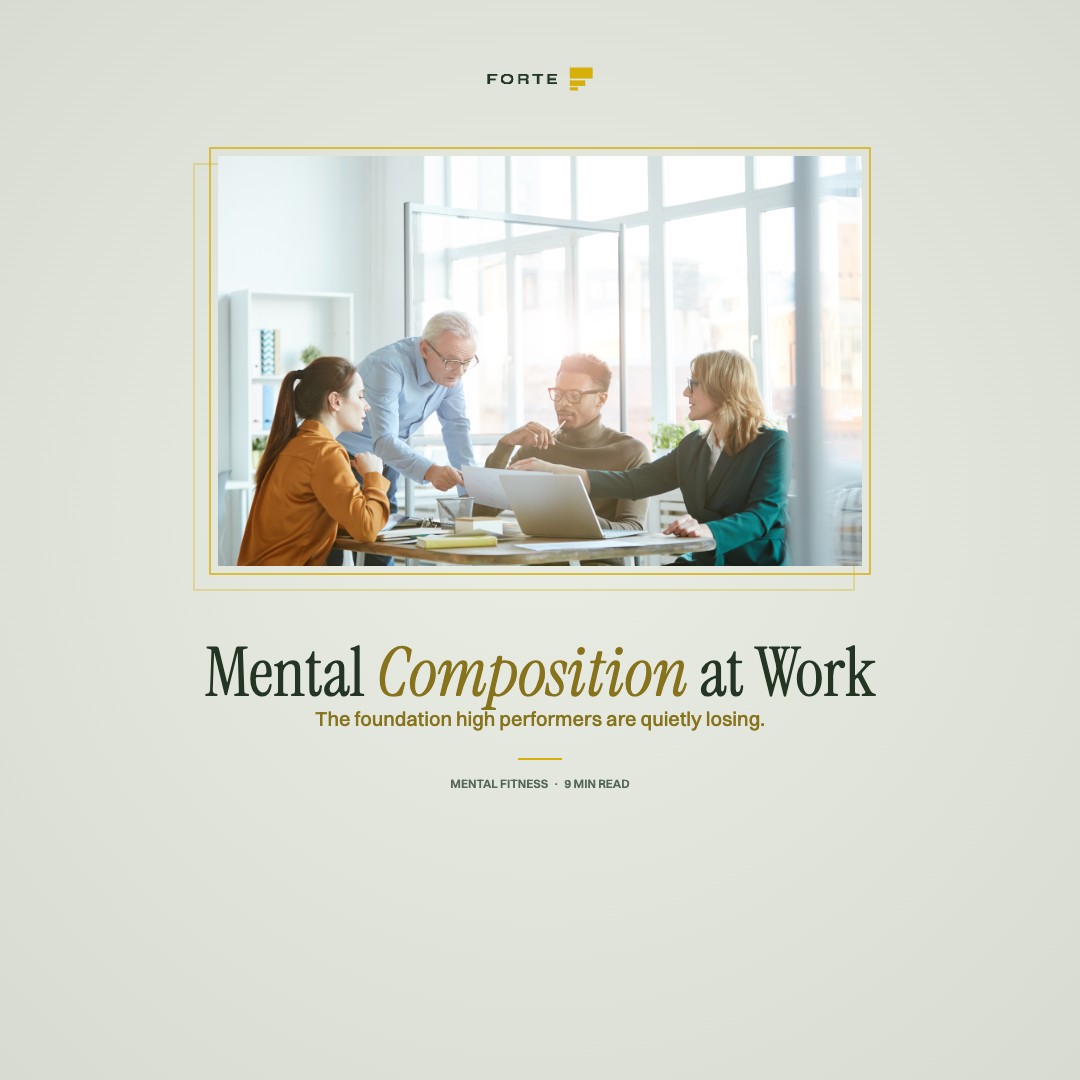
Something shifts in a high performer and nobody can quite name it. They still show up. They still deliver. But the clarity they once carried into every room has quietly dimmed.
The Drift Nobody Names
Their decisions take longer. Their confidence in one-on-ones feels borrowed rather than earned. Peers notice before managers do, and managers notice before HR does. By the time it surfaces in a performance conversation or an exit interview, the drift has been happening for months.
This is not a burnout story, although burnout may follow. It is a story about mental composition, the internal architecture that determines how a person knows themselves under pressure, in transition, and across the shifting demands of organizational life.
When that architecture is solid, people perform with consistency and recover with speed. When it erodes, everything downstream gets harder, from communication to decision-making to retention. If you are new to how Forte thinks about this, start with the Mental Fitness overview.
Why High Performers Suddenly Lose Their Footing
Organizational psychologist Amy Wrzesniewski at Yale has spent decades studying how people construct meaning at work. Her research reveals something counterintuitive: the employees most likely to experience identity drift are not the disengaged ones. They are the deeply invested ones, the people who tied their sense of self tightly to a role, a mission, or a team, and then watched that context change around them.
Reorganizations, leadership transitions, rapid scaling, return-to-office mandates, AI-driven role redefinition. Every one of these events stress-tests a person's internal sense of who they are at work. For employees with strong Composition, those events are turbulent but navigable. For employees without it, the ground genuinely disappears.
The employees most likely to drift are often the most committed. They invested their identity in a context that changed. Composition is what keeps that investment from becoming a liability.
The gap is not talent. It is not work ethic. It is the presence or absence of a stable psychological foundation, what Forte defines as the pillar of Composition within its Mental Fitness framework.
What Mental Composition Actually Is
Mental Composition is the first and foundational pillar of Forte's Mental Fitness framework: the trainable capacity to maintain clarity about who you are, what you value, and how to stay grounded when organizational pressure or change threatens that sense of self.
It is not about being emotionally flat or stoic. Composed employees can feel the full weight of a difficult quarter, a difficult conversation, or a difficult transition without losing the thread of who they are inside it.
Research published in the Journal of Personality and Social Psychology found that employees with high self-concept clarity demonstrate more consistent behavior under stress and report stronger workplace relationships, a finding that has held up across replication studies for nearly three decades. For HR leaders, this matters because it means Composition is not a personality trait some employees were born with and others were not. It is a trainable capacity. And that changes the conversation entirely.
Where Composition Sits in the Mental Fitness System
Forte's platform is built on four permanent pillars: Composition, Capacity, Flexibility, and Endurance. Composition is the first for a reason. It is the foundation beneath the others.
Composition
Psychological identity clarity. Knowing who you are, what you value, and how to stay grounded when the environment shifts.
Capacity
Mental and emotional bandwidth. The ability to absorb pressure without fragmenting.
Flexibility
Cognitive adaptability. Moving through change without losing coherence or trust.
Endurance
Sustained performance. Maintaining quality across months and years, not just peak moments.
Composition shows up in the texture of everyday work rather than in dramatic moments. The manager who stays grounded when an employee pushes back hard. The project lead who pivots strategy without losing the team's confidence in their steadiness. The contributor who integrates critical feedback without crumbling or becoming defensive. These look like communication skills from the outside. They are expressions of a person who knows who they are and is not performing stability while quietly unraveling.
What Happens When Composition Breaks Down
Identity drift is gradual, which is what makes it so costly and so easy to miss. An employee experiencing Composition breakdown does not submit a help ticket. The erosion shows up at three levels.
-
The individual.
They start second-guessing decisions they would have made confidently six months ago. They become harder to read in one-on-ones. They begin mirroring the strongest voice in the room rather than contributing their own perspective.
-
The team.
When Composition breaks down across multiple people at once, which is exactly what large-scale change produces, psychological safety erodes. People stop saying what they actually think. Collaboration becomes performance. Innovation stalls.
-
The leader.
A senior leader who has lost their psychological footing externalizes that instability in both directions, down to their reports through inconsistency, and up to executives through behaviors that look like disengagement or politics.
This is not a values problem. It is not a culture problem. It is a Mental Fitness problem with a specific name: Composition deficit.
When Composition breaks down across teams, psychological safety is the first casualty. Teams start performing alignment they do not actually feel.
How HR Leaders Build Composition at Scale
The instinct in People functions is to respond to identity instability with culture programming, values workshops, all-hands alignment sessions. These are not wrong, but they address the environment, not the individual's internal architecture. Building Composition at scale requires three things working together.
-
Structured self-inquiry.
Employees need dedicated space and skilled support to examine their own values, behavioral patterns, and identity narratives. This is the work executive coaches have delivered to the C-suite for decades. Forte makes it accessible to every level, with Sessions bookable within 24 hours.
-
Consistent language.
When Composition becomes a shared concept, managers can name what they are observing and employees can name what they are experiencing. Conversations that would have been vague or avoided become navigable. Language is not cosmetic. It is structural.
-
Coach quality.
Self-awareness development with low-quality facilitation can entrench unhelpful self-narratives rather than expand them. Internal reflection without skilled external input frequently leads to rumination rather than insight. The quality of the Coach matters enormously.
Self-awareness work with low-quality facilitation can entrench unhelpful narratives rather than expand them. The quality of the Forte Coach determines whether Composition work actually lands.
The numbers underneath this are striking. Psychologist Tasha Eurich found that only 10 to 15 percent of people are genuinely self-aware, despite 95 percent believing they are. Composition development is what closes that gap, with structured, Coach-led support rather than another self-assessment.
Forte's platform is rated 4.9 stars by the employees who use it, and Sessions are bookable within 24 hours. That is not a marketing number. It is a signal about practitioner quality and the experience of actually feeling seen and supported rather than processed.
What becomes visible over time is Drive. Not frantic hustle, but the anchored, purposeful forward movement of people who know who they are and what they are for.
Forte is not therapy. It is not an EAP. It is proactive Mental Fitness training that treats psychological development with the same seriousness organizations apply to professional skills, built to strengthen the internal architecture that makes great work possible before the crisis arrives.