






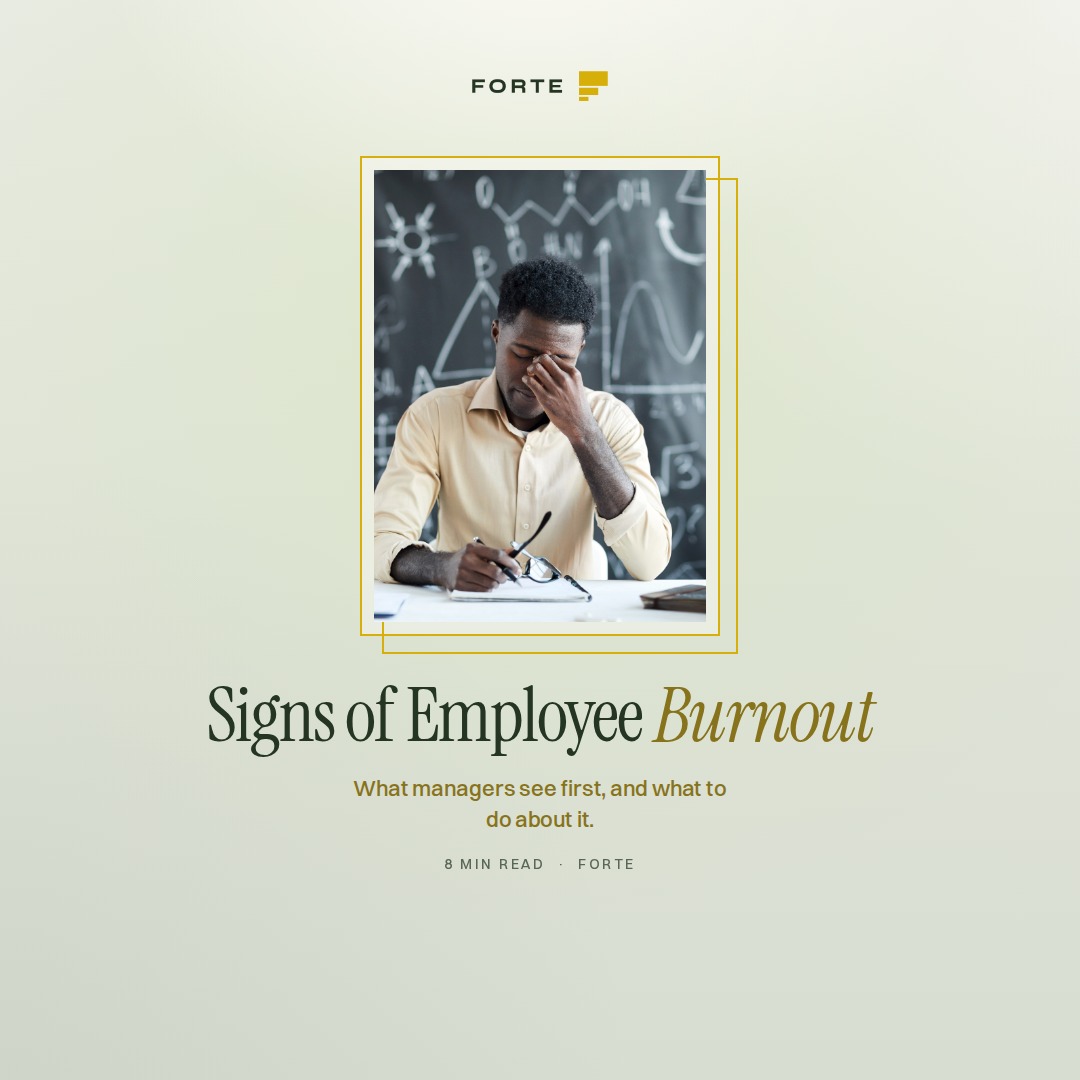
You already know what burnout looks like when it lands. What is harder to name is what came before.
What Comes Before Burnout (And Why It's Harder to See)
A resignation letter. A performance review that goes sideways. A person who used to bring energy to every room now barely making eye contact.
Drift is quieter. The signs of employee burnout almost never arrive with a warning. They build slowly, in the margins, and by the time most managers notice them, the team is already somewhere it never chose to be.
This is about the six months before the crisis hits. And what you can actually do about it.
Burnout is a state of chronic depletion. Drift is the road that leads there.
Drift happens when a person loses their felt sense of direction. Not dramatically. Gradually. They stop connecting their daily work to something that matters to them. Their decisions become reactive rather than intentional. They show up, but something essential is running on low.
This is where Composition and Capacity, two of the four pillars of Mental Fitness, become the lens that changes what you see.
Mental Fitness is a term worth defining here. It is not therapy. It is not an emergency intervention.
Mental Fitness is the training of Agency: the deliberate cultivation of the capacity to act with intention, clarity, and alignment.
Think of it the way you think of physical fitness. You do not go to the gym because you are already injured. You go so you do not get injured.
Composition is the pillar that addresses identity, values, and clarity. It is the internal anchor that helps a person know who they are and what they are doing here. Capacity is the pillar that builds focus, stress tolerance, and resilience. Together, they are the infrastructure a person needs to stay grounded under pressure.
When those two things erode, drift sets in. And drift, left unaddressed, becomes burnout.
Composition
Identity, values, clarity. The internal anchor that helps a person know who they are and what they are doing here.
Capacity
Focus, stress tolerance, resilience. The trained ability to stay functional under pressure without paying the hidden cost of depletion.
Flexibility
The capacity to adapt, reframe, and stay open when conditions change.
Endurance
Sustained drive across time. Motivation that stays connected to meaning.
Five Signs of Employee Burnout Before It Becomes a Crisis
None of these signals are dramatic on their own. That is exactly the point. You are looking for a pattern, not a crisis.
-
Decisions take longer than they should.
A person who used to move with confidence starts second-guessing, over-consulting, or stalling. This is not incompetence. It is often a sign that their internal compass has gone quiet. Composition, the clarity of values and identity, is what makes confident decision-making possible. When it dims, everything slows.
-
Energy is present but engagement is not.
They are meeting their deadlines. They are responding to messages. But there is a flatness to it. No curiosity. No initiative. They are doing the job without being in it. This is a Capacity signal. The fuel is running low even when the output looks acceptable.
-
They have stopped saying what they actually think.
You notice it in meetings. The shrug instead of the opinion. The agreement that feels too quick. When people drift, they often conserve energy by withdrawing from the friction of real contribution. It feels safer to go along.
-
Small things land harder than they should.
A missed deadline, a piece of feedback, a change in process. The reaction is disproportionate. That disproportionality is data. Stress tolerance has dropped. Their nervous system is already running above capacity.
-
They have stopped talking about the future.
Listen for this one. People who are grounded in their work talk about what is coming, what they want to build, where they want to go. Drifting people talk about what is in front of them right now. The horizon has shortened. That is not laziness. It is depletion.
Why Managers Miss the Early Signs of Employee Burnout
Most managers are trained to manage outcomes, not inner states. If the outputs are fine, the assumption is that the person is fine.
The signs of employee burnout almost never show up first in performance data. They show up in tone, in pace, in the quality of someone's presence. And those things are easy to explain away.
She is just tired. It has been a big quarter. He is going through something at home. They will bounce back.
Sometimes that is true. But sometimes that explanation is a way of avoiding a harder question: what would it mean if they will not bounce back on their own?
Managers are not therapists, and they should not try to be. But they can be attentive. They can create conditions where people are not just surviving their work.
What Proactive Burnout Prevention Actually Looks Like
This is where Forte comes in, and where the gym analogy matters.
Forte is not an emergency room. It is a gym. Members work with Forte Coaches, trained Mental Fitness professionals, through Sessions bookable within 24 hours. The work is proactive. It happens before the breakdown, not after it.
When Composition is trained, a person reconnects with what they value and why their work matters to them. That clarity is protective. It is hard to drift when you know where you are going.
When Capacity is trained, a person builds genuine stress tolerance. Not the kind that white-knuckles through pressure, but the kind that metabolizes it. They stay functional without paying the hidden cost of depletion.
Rated 4.9 stars across more than 2,000 reviews, the Sessions Members return to again and again are not crisis management. They are training. Regular, intentional, inner life work that accumulates over time.
That is the difference between a team that drifts and a team that does not.
Burnout Is Preventable. But Only If You Move First.
You can see the signals of drift before they become a resignation, a breakdown, or a performance problem. You can build the kind of culture where people are training their inner life the same way they build any other skill.
But that requires moving before the crisis. Not after it.
If you are seeing any of these signals in your team, that is not a reason to panic. It is a reason to act.