







Is someone on your team already halfway out the door? If January has ever handed you a resignation you didn't see coming, the decision was almost certainly forming well before the letter showed up. Job searching peaks every January. Glassdoor's data shows it is typically the strongest month of the year for it (Glassdoor, 2025).
But nobody decides to quit on December 22. A real conversation in the fall can change what a person carries into the new year. A retention plan in December usually can't.
The good news is that what your people need in October is mostly small. And you still have weeks.
- January is typically the strongest month for job searching. Glassdoor projected job seeker activity about 11% above a typical month in January 2025 (Glassdoor, 2025).
- 42% of employees who voluntarily left say their manager or organization could have done something to prevent it (Gallup, 2024).
- 45% of voluntary leavers say no manager or leader proactively talked with them about their job satisfaction, performance, or future in the three months before they left (Gallup, 2024).
- Not feeling valued by the organization (54%) or by their manager (52%) topped the reasons people gave for quitting (McKinsey, 2021).
Why Does January Feel Like the Worst Month to Lose Someone?
January is typically the busiest month for job seeking in the U.S. For January 2025, Glassdoor projected job seeker activity about 11% above a typical month, with the week of January 13 running about 19% above a typical week (Glassdoor, 2025). People take the holiday lull to think, then act when the new year starts.
You open your email on the second Monday of January. The subject line reads "I wanted to talk." You already know. The timing isn't an accident. Someone made a decision weeks ago, waited for a natural pause, and used it.
If you're reading this in October or November, you're still ahead of it.
When Do People Actually Decide to Leave?
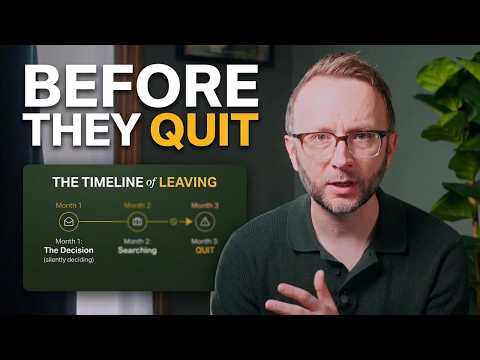
Long before the letter. Gallup found that 42% of employees who voluntarily left say their manager or organization could have done something to prevent it, and 45% say no manager or leader proactively talked with them about their job satisfaction, performance, or future in their final three months (Gallup, 2024).
Gallup can't say which month people decide. The pattern is clear, though. Picture how it plays out. Something happens, or more often, something doesn't. Nobody asks how they're doing, and they notice. A hard week comes and goes without a word from anyone. They go home on a Thursday, sit across from their spouse, and say, "I think I need to find something else." Then they tell you nothing, keep doing the job well, and wait for the new year.
A good person leaves quietly after deciding months ago. The letter in January is just the paperwork.
Many leaders feel this one: I should have seen it coming, and I don't know who is already halfway out the door. That feeling isn't a character flaw. You run a school, a hospital unit, a congregation, a nonprofit on a tight budget. You can't sit with every person every week. Someone can, and we'll get to that.
What Did They Actually Need in October?
When McKinsey asked people who had quit why they left, the top answers were that they didn't feel valued by their organization (54%) or by their manager (52%), or that they didn't feel they belonged (51%) (McKinsey, 2021). Pay matters, but it isn't the whole story.
What a person needed in October was smaller and more human than a compensation review.
They needed someone to notice. A manager who said, "You seem a little off this week. Everything okay?" and then waited for the answer.
They needed one real conversation. Not a performance review, not a survey link. Five minutes where someone said their name and meant it.
They needed a reason to stay that connected to something they care about. Not the mission statement on the wall. The actual work they chose this field for, named out loud.
That's the list. No new program and no benefits upgrade. A person who noticed.
What Does a Real Conversation Sound Like?
Here's the version that doesn't work. You stop someone in the hall and say, "How's it going?" They say, "Good, busy." You say, "Hang in there." You both keep walking. That was noise.
Here's the version that does. You ask to sit down for ten minutes, no agenda. You say, "I've been thinking about you. This semester has been a lot. What has been hardest?" Then you stop talking.
You don't solve anything in that meeting. You listen, and you say it back. "So the part that's wearing you out is feeling like nobody above you knows what it costs you. Is that right?" They say yes. You say, "I want you to know I see that. I can't fix all of it, but I wanted you to hear that it matters."
You don't need a script. You need to mean it, and you need to stay in the chair.
You don't have to fix anything in that conversation. You just have to stay in the chair long enough for them to feel heard.
What Happens If You Skip It?
A good person hands you a letter in January. You spend February covering their work, March interviewing, and April onboarding someone new. By August you're wondering whether the new hire will stick. That's one person, and you may have three or four in the same quiet moment right now.
The stakes are human before they're logistical. Someone chose your school, your hospital, or your church because they believed in it. They walk away feeling they didn't matter enough for five minutes of anyone's time. That stays with them. It stays with the people who watched them go.
How Do You Reach the People You Can't Sit Down With?
You can't sit down with everyone, and no leader can. Your care is real and your hours aren't unlimited. The work is finding a way to extend that care to the people you can't reach yourself.
That's where Forte comes in. A Forte Coach gives every person on your team a real human who knows their name, listens, says it back, and needs nothing from them in return. Advice on how to perform and answers from AI are everywhere. A person who listens is rare. You can meet the Coaches at getforte.com/coaches and see how it all fits together at getforte.com/how-it-works.
Mental Fitness is how Forte does this work. For some people, it means finally talking to someone. For others, it means slowing down enough to notice what matters. Every person gets a Coach who knows their story, and Members can connect with their Coach as early as the next day.
When people feel known, they show up whole, at home and at work. You become the leader whose care reaches every person, not just the ones whose offices are near yours.
A real human for every person.
If you want one low-friction step first, start with the free Five-Day PACER Plan. It's a short daily practice you can try with your team this week, with no app to install and nothing to buy. Get the free Five-Day PACER Plan
Is someone on your team carrying more than they're letting on? Give every person a real human Coach, and your people will feel known and show up whole, at home and at work. When you're ready to see how Forte works for your organization, book a demo. Book a Demo